

Sugar Rush: The Art of Wayne Thiebaud

Catch the exhibition at The Courtauld in London. Ends Sunday18 January, 2026.
Wayne Thiebaud. American Still Life
An exquisite exhibition showcasing the art of American Artist Wayne Thiebaud. On a dreary winter day, it offers the perfect visual "sugar rush".
The exhibition at The Courtauld (London) is the first museum display of his work in the UK. It features Thiebaud’s extraordinary, vibrant, and richly painted still-lifes of distinctly post-war American themes, including diner food, deli counters, gumball machines, and pinball machines. These are the paintings that established Thiebaud's reputation in the USA in the early 1960s.
The exhibition includes rarely loaned works from prominent museum collections in the USA, such as the National Gallery of Art, Washington, and the Whitney Museum of American Art, along with the Wayne Thiebaud Foundation.
Here are selected works of what is on display.
All text in art labels from The Courtauld.
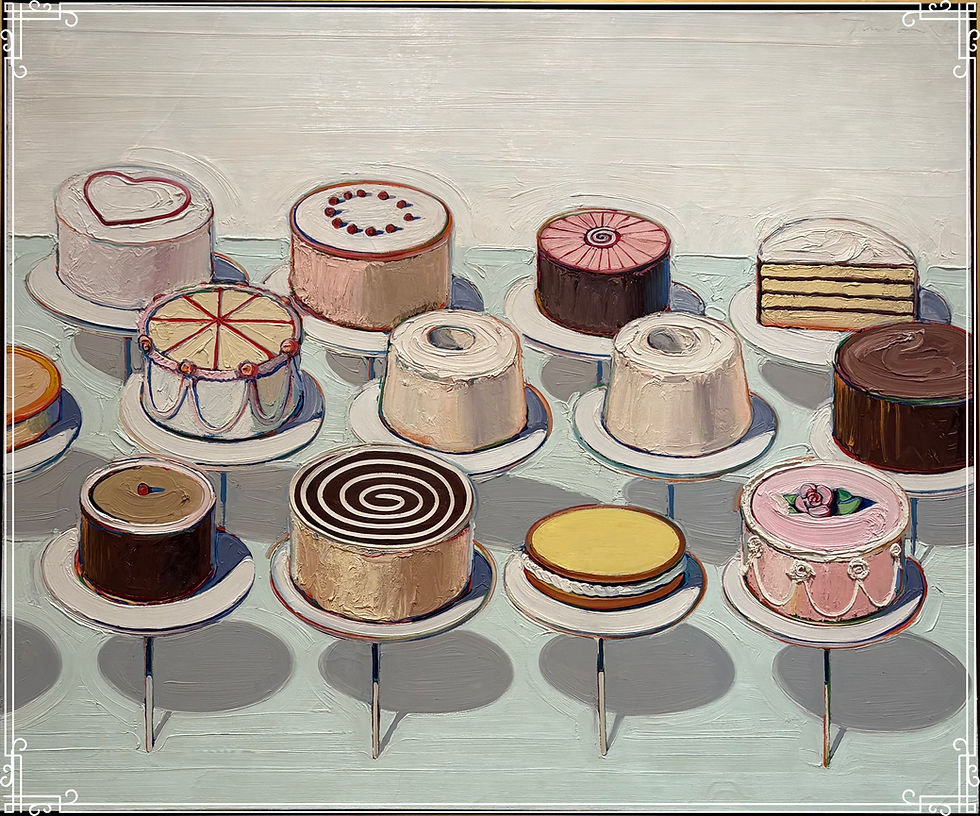
In this celebrated painting, Wayne Thiebaud gives an epic account of one of his favourite motifs, a display of bright and brash cakes familiar from bakeries and diners across America. Working on an unusually large scale for a still-life painting, he accords both the genre itself and his commonplace subject matter monumental status. Thiebaud uses his paint thickly and lushly to accentuate what he considered the distinctly American character of the patterned, vividly coloured and excessively frosted offerings. Cakes was a standout work in exhibitions in New York and Los Angeles in 1963 and helped confirm Thiebaud's emerging reputation as a distinctive painter of modern American life.
Borrowed from: National Gallery of Art, Washington, D.C. Gift in Honor of the 50th Anniversary of the National Gallery of Art from the Collectors Committee, the 50th Anniversary Gift Committee, and The Circle, with additional support from the Abrams Family in memory of Harry N. Abrams.

Wayne Thiebaud's interest in objects of everyday consumerism meant that he was often categorised as a Pop artist and was included in several seminal Pop Art exhibitions throughout the 1960s. However, his lushly painted works are at odds with the cool detachment and slick surfaces more typical of that movement. This painting shows Thiebaud working at the extreme of his distinctive approach, with its whipped, buttery brushstrokes conjuring the substance of the creamy cakes themselves. As he put it, white, gooey, shiny, sticky oil paint spread out on the top of a painted cake becomes frosting. It is playing with reality.
Borrowed from: Crocker Art Museum.

The character of Wayne Thiebaud's art changed dramatically in 1961, as the loose brushwork of his earlier paintings gave way to more clearly rendered and tightly composed forms. Penny Machines marks the beginning of this transition.
Its line-up of three boldly painted sweet dispensers has what Thiebaud called a new
'head-on directness' that confidently presents these common commercial objects as small monuments. He uses sweeping strokes of thickly brushed paint to construct the surfaces in bold blue and pink - colours that he would soon cease to use for his backgrounds, preferring more neutral creams and whites.
Borrowed from: Collection of John Berggruen

Candy Counter is one of Wayne Thiebaud's earliest large-scale still lifes of everyday modern American subjects. It crystallised his new approach of working with greater clarity and directness. As was typical for the artist, he painted from memory rather than with the subject in front of him. He started by defining the counter with painted lines of vibrant colour before building up the composition with thick brushstrokes. He carefully depicted the tempting selection of lollipops, candied apples and slabs of nougat. However, the counter is surprisingly sparse and stark.
As one writer commented: 'Despite their sweet and infectious child-like pleasure in vernacular Americana, paintings by Thiebaud reveal a bitter pang of isolation and melancholy in pop culture!’
Borrowed from: Anderson Collection at Stanford University, Palo Alto Gift of Harry W. and Mary Margaret Anderson, and Mary Patricia Anderson Pence.

Some of Wayne Thiebaud's most poignant works isolate just a single object. Here, a last slice of cherry pie remains in a glass case on a countertop. Thiebaud explained how he recalled fragments of youthful memories as he painted: 'From when I worked in restaurants, I can remember seeing rows of pies, or a tin of pie with one piece out of it. Those little vedute [views], in fragmented circumstances, were always poetic to me.'
Borrowed from: San Diego Museum of Art.

Painting pies set Wayne Thiebaud on a new artistic path. In the early 1960s, he produced several closely related versions of this breakthrough composition, drawing on his memories of working in restaurants. The simplicity of the shapes - rows of circles and triangles - reminded him of Paul Cézanne's claim that authentic painting should be built from basic forms. Thiebaud's paintings of pies were standout works in his highly successful debut exhibition at the Allan Stone Gallery in New York in 1962. It presented a rich display of some 46 paintings, hung in stacked groups, most of which were bought by prominent collectors and major museums.
Borrowed from: Collection of the Wayne Thiebaud

Wayne Thiebaud was fascinated by the colours and decorative patterns that recurred across a range of modern consumer products. In this depiction of children's yo-yos, he relishes painting their bright swirls and stars. It could easily be mistaken for one of Thiebaud's paintings of cakes or candies. Where others might have seen banal uniformity in such cheap, mass-produced objects, Thiebaud explored the beauty of their small differences. Here, his attentive and thickly applied brushwork introduces idiosyncrasies in each object, creating a strange transposition of the factory-produced yo-yos remade by the artist's hand.
Borrowed from: Buffalo AKG Art Museum. Gift of Seymour H. Knox, Jr.,

Wayne Thiebaud's life-size depiction of a jackpot machine confronts us head-on. He had long been fascinated by their strangely human-like form. Rather than a specific model, Thiebaud imagined his own 'one-armed bandit', with its rounded coin-slot eye, money-shoot mouth and lever-arm raised up and ready to take on its players. The reels on his machine record an incomplete line, with a win tantalisingly out of reach. Thiebaud accentuates the Americanness of this icon of popular entertainment by painting it the red, white and blue of the American flag, complete with stars and stripes. It seems to embody the much-debated characterisation of this period in the United States as a golden age of economic optimism.
Borrowed from: Smithsonian American Art Museum, Washington, D.C.

Although associated with gambling and banned in some cities, pinball machines became an American phenomenon and were hugely popular across the country in the 1950s and 1960s.
One of Wayne Thiebaud's most ambitious and complex works, this painting seems, at first glance, to be a straightforward depiction of an arcade of brightly coloured pinball machines waiting to be played. However, Thiebaud redesigned their square backglasses to recall recent developments in abstract painting, such as the squares of Frank Stella, the targets of Kenneth Noland and the grids of Ellsworth Kelly. In doing so, Thiebaud folded together contemporary art and popular culture, presenting both as modern entertainment.
Borrowed from a Private collection. Courtesy Acquavella Galleries.

Depicting the cheeses and baloney sausages on offer at a deli counter, Wayne Thiebaud painted so thickly that every brushstroke is accentuated.
He explained that he wanted to emphasise different textures to explore 'what happens when the relationship between paint and subject matter comes as close together as I can possibly get them.' At the same time, Thiebaud liked how the obvious traces of the brush exposed what he called the 'trick' of painting itself.
He also paid great attention to perfecting the calligraphy of the numbers on the price cards, a nod to his admiration for the skill of commercial artists, with whom he trained.
Borrowed from: The Menil Collection, Houston.


Comments