

The Female Collector’s Eye

Updated: Feb 3
‘To establish the Dream of realities, the Ineffable soaring above them, to dissect them without pity to see their Soul, to strive for the pursuit of the Intangible and meditate – in silence – to inscribe the mysterious Meaning.’ - Henry van de Velde -
Radical Harmony: Helene Kröller-Müller’s Neo-Impressionists
This blog highlights selected pieces from the National Gallery London's Radical Harmony Exhibition, which runs until 8th February 2026. The exhibition primarily features works from the collection of German art collector Helene Kröller-Müller (1869‒1939), housed at the Kröller-Müller Museum in Otterlo, Netherlands. Radical Harmony focuses on how this style that emerged from 1886 when Georges Seurat exhibited his work 'A Sunday on La Grande Jatte' at what was to prove the final Impressionist exhibition heralded the end of Impressionism and, became one of the very first pan-European art movements.
Who was Helene Kröller-Müller?
Helene Kröller-Müller, one of the foremost female art patrons of the 20th century, curated what is likely the world's most extensive and comprehensive collection of Neo-Impressionist paintings. She was a pioneer in displaying modern works of art on white walls; within a museum designed by Belgian architect Henry van de Velde. Van de Velde was himself a Neo-Impressionist painter at the beginning of his career.
Kröller-Müller was also the first to recognise the significance of Vincent van Gogh’s unusual painting style. Over just three decades, she amassed a magnificent collection of some 11,500 objects, featuring luminaries of Neo-Impressionist and Modern art, including Camille Pissarro, Georges Seurat, Pablo Picasso, and Piet Mondrian. The exhibition at the National Gallery is just a small representation of her collection.
In describing the first museum she opened in 1913, Helene Kröller-Müller was delighted by the contrast created by her room of Van Goghs, in her words - 'dramatic and heavy, like hammer blows' - and the 'light and delicate, spiritual' qualities of her Neo-Impressionist paintings.
Prior to becoming a collector, Helene Kröller-Müller studied art appreciation with the critic and former Neo-Impressionist painter Hendricus Petrus (Henk) Bremmer (1871-1956). Bremmer's passion for the movement, along with his friendships with many Dutch followers of the group such as Jan Toorop and newcomers like Johan Aarts (1871-1934) and Johan Thorn Prikker (1868-1932), inspired Kröller-Müller's deep affection for their remarkably minimalist landscapes. These works became the cornerstone of her extraordinary Neo-Impressionist collection.
She believed, as did many of the artists gathered in this room, that it was art's duty to extract a deeper, spiritual significance from the world of appearances. She hoped the public would be moved by these pictures' profound sense of peace and by what she perceived as their great emotional depth.
For more on Kröller-Müller, visit Kröller-Müller Museum webpage here.
Description derived from that found in the exhibition at the National Gallery London.
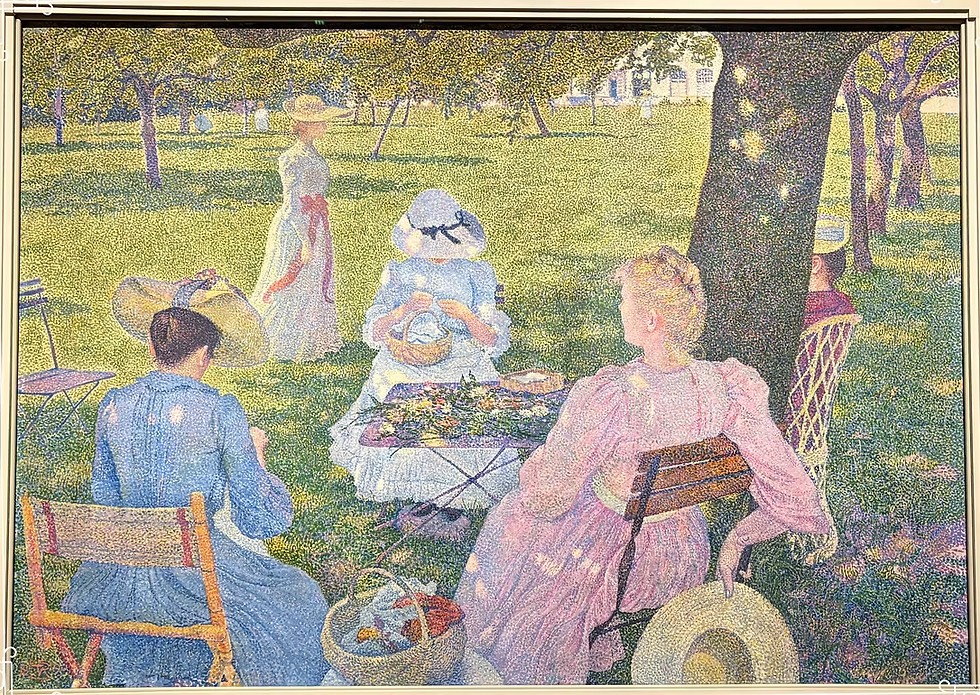
For an artist so well known for his portraits, Van Rysselberghe here conceals the faces of the women gathered in an orchard, most strikingly and playfully cutting off the profile of the woman on the far right with a tree trunk. Each figure is shown absorbed in her own thoughts and activities. The suggestion is one of companionable silence within the stillness brought on by noon-day heat.
While faceless, the identities of the two women seen from behind are known: in blue is Maria Monom, the artist's wite, while in pink is their mutual friend, Maria Sèthe (see 3. Portraits).
Oil on canvas
Kröller-Müller Museum, Otterlo, The Netherlands
Text by National Gallery London.

At Portrieux, in northern Brittany, Signac created an overlapping series of views of the lighthouse and harbour wall under different light and weather conditions. The Neo-Impressionists' concern for capturing atmospheric effects was something they shared with the Impressionists.
But their search for simplified forms combined with their painstaking technique separated them from the earlier movement. Signac gave both pictures Opus numbers, a cataloguing system he adopted to suggest an equivalence between his art and musical compositions.
Oil on canvas
Kröller-Müller Museum, Otterlo, The Netherlands.
Text by National Gallery London

Luce witnessed the inhumane working conditions of steel workers in the industrial heartlands of southern Belgium. But here, he chose to focus on the men's strength and integrity. Backlit by molten metal, they work together in an anarchist ideal of creative co-operation. The figures on the right even enjoy a moment of rest.
Kröller-Müller bought this picture directly from Luce in 1922 and it was without any apparent sense of irony that for many years it hung in the office of her husband, Anton Kröller, who ran the family's iron ore and shipping business.
Oil on canvas
Kröller-Müller Museum, Otterlo, The Netherlands.
Text by National Gallery London


Luce, a member of the Anarchist Group of the 14th arrondissement of Paris, pays homage to the everyday routines of artisanal labour in depicting his friend Gustave Perrot, a painter and architectural gilder, getting dressed for work. Luce suggests that artists and artisans are workers too.
The pictures hanging in the attic room illustrate the anarchist belief that art should be available to all, while the painting itself is an aesthetically balanced construction of diagonal lines and rich contrasts of colour.
Oil on canvas
Lent by The Metropolitan Museum of Art, New York.
Text by National Gallery London
Seascapes
L to R (desk top view)
By Paul Signac. Saint-Briac, The Beacons, Opus 210, (1890) - oil on canvas, private collection.
By Henry Van de Velde. Seashore (Beach at Blankenberghe), (1889) - oil on canvas, Kunsthalle Bremen - Der Kunstverein in Bremen.
By Henri-Edmond Cross. Beach at La Vignasse (c. 1891-2)n- oil on canvas, Le Havre, Musée d'art moderne André Malraux.

Painted in a limited palette of mainly blues and whites, Van Rysselberghe reduces the elements of this view - spits of land meeting sea and sky - to their barest minimum. Six posts within a glowing patch on the water provide the only signs of a human presence in the otherwise deserted landscape. Despite its cool tonality, the picture was probably painted when Van Rysselberghe was travelling with Signac on the Mediterranean coast of France.
Oil on canvas
The National Gallery London.
Text by National Gallery London

Cancan or Chahut
The men and women in this painting are energetically performing the chahut, or cancan, a daring dance for its time, where the women lift their skirts and kick their legs into the air.
Although the subject is lively, Le Chahut is not a spontaneous snapshot of Parisian nightlife but a meticulously crafted artwork. Seurat is intrigued by the interplay of light and color and intentionally seeks a systematic approach to portray this effect. He has depicted the vibrant dance using a precise technique of countless tiny dots of paint, lines, and color combinations.
The dancehall is enveloped in warm hues and radiant artificial light. The dancers resemble archetypes rather than real people. They move in rhythmic repetition. Every line and movement in the painting is directed upwards to convey the exhilarating atmosphere of the dance and music: the dancers’ legs, the conductor’s hand, the men’s moustaches, the corners of the women’s mouths and eyes, the neck of the double bass, and even the flowers in the background.
Seurat's Chahut (1889-90) is the greatest Neo-Impressionist painting collected by Helene Kröller-Müller, and one of Seurat's most important works. One of his toiles de luttes (battle canvases), as he liked to refer to his most provocative manifesto pictures, Chahut was the last such painting the artist brought to completion before his untimely death in 1891, aged 31.
Helene Kröller-Müller's purchase of Chahut in 1922 made it the first major work by Seurat to be acquired for public display. Two years later, the National Gallery London bought Bathers at Asnières (1884), on view in Room 44.
Oil on canvas
Kröller-Müller Museum, Otterlo, The Netherlands.
Description summarised from text provided by the Kröller-Müller Museum and The National Gallery London.


Constructed from three bold horizontal bands - the foreground grass, a row of cottages and the sky - Van de Velde captures the low light of evening in a harmony of purples and greens. The lone figure of an elderly woman, her hunched shoulders caught by the evening light, gives the picture its chief focus which, combined with the fragile lines of tall saplings lining the path, lends the scene an air of profound melancholy.
Oil on canvas
Kröller-Müller Museum, Otterlo, The Netherlands
Text by National Gallery London.
Portraits and Groups
Traditionally, a portrait is expected to depict a precise likeness. This contrasts with the Neo-impressionist belief that artistic harmony should be achieved by distilling form into a more generalised representation.
Top row, L to R (desk top view)
By Georges Seurat. Paul Signac, (1890) - conte crayon on paper, private collection.
By Théo van Rysselberghe. Anna Bloch, (1892) - oil on canvas, Michele and Donald D'Amour Museum of Fine Arts, Springfield, Massachusetts.
The James Philip Gray Collection
By Georges Lemmen. Jan Toorop, (1890) - conte crayon on paper, Museum de Fundatie, Zwolie and Heino/Wijhe, The Netherlands.
Bottom row, L to R (desk top view)
By Paul Signac. A Sunday, Opus 201, (c. 1888-90) - oil on canvas, private collection.
By Théo van Rysselberghe. Maria Sethe at the Harmonium, (1891) - oil on canvas, Royal Museum of Fine Arts Antwerp - Flemish Community.
By Paul Signac. The Dining Room, Opus 152, (c. 1886-7) - oil on canvas, Kröller-Müller Museum, Otterlo, The Netherlands.


Comments