

Sol, Luna, et Ars

The Sun and The Moon: Art Inspired by the Celestial Exhibition at Saatchi Gallery (5 June - 8 September 2026)
The Celestial Equation
Sol = Sun
Luna = Moon
Ars = Arts
With the Solar eclipse scheduled for 12 August 2026 in the UK; why not explore the Celestial Exhibition at the Saatchi Gallery? Here are my reflections alongside selected artworks. Texts marked with (sg) are from the Saatchi Gallery.
The Hooded Moon
What counsel has the hooded moon
Put in thy heart, my shyly sweet,
Of Love in ancient plenilune,
Glory and stars beneath his feet — -
A sage that is but kith and kin
With the comedian Capuchin?
~ from 'What Counsel has the Hooded Moon' by James Joyce ~

Mixed media (3D-printed PLA and PETG, wood, steel, polyurethane foam, resin, filler, acrylic paint).
Courtesy of the artist
Starman
There's a starman waiting in the sky
He'd like to come and meet us
But he thinks he'd blow our minds
~ from Starman by David Bowie.
Released on April 28, 1972, as the lead single for his album ‘The Rise and Fall of Ziggy Stardust and the Spiders from Mars’ ~

Cast Marble Resin with Chromed Visors. Courtesy of the artist.
About Whatshisname
Whatshisname is the moniker of Sebastian Burdon, an artist who creates iconic and unforgettable sculptures, prints and public art. The smaller sculptures that you see here were originally conceived as a series entitled One Small Step. The larger, breakdancing astronaut, is a new XXL rendition of a smaller work that was sent to the edge of Earth's atmosphere in 2023.
In the words of the artist: In these sculptures, astronauts step away from the familiar image of space exploration to do something completely unexpected: dance. A breakdancer balancing on one hand, a ballet dancer poised on a single leg, a pair performing an iconic lift, and two astronauts sharing an embrace. Together, they turn the moon into a stage filled with movement, joy, and human connection.
The series was inspired by the 1969 moon landing. This awe-inspiring event proved that if people could travel to the moon, then perhaps the limits we place on ourselves are not as fixed as they seem.
The sculptures celebrate both that spirit of exploration and the simple moments that make us human. The space suits hide the identities of the figures, allowing them to represent anyone. They become dancers, dreamers, friends, and explorers, reminding us that creativity, curiosity, and connection can exist anywhere, even on the surface of the moon.
Each sculpture is made from cast marble resin, a blend of resin and marble dust that gives the work a soft shimmer and a subtle glow reminiscent of moonlight. Through this series, the artist invites viewers to see astronauts and the world around them in a different way. (sg).
Unruly Sun
Busy old fool, unruly sun,
Why dost thou thus,
Through windows, and through curtains call on us?
~ from 'The Sun Rising' by John Donne ~

Measuring six metres in diameter, Helios features detailed imagery of the sun's surface. At an approximate scale of 1:230 million, each centimetre on the surface of the globe represents 2300km of the sun's surface.
The installation is a fusion of solar imagery, sunlight and a specially created surround sound composition by Duncan Speakman and Sarah Anderson.
It is very dangerous to look at the sun directly as it can damage our eyesight, so Helios provides a safe opportunity for the public to get up close to, and inspect its extraordinarily detailed surface, including sunspots, spicules and filaments. The sculpture also features the source of the solar flares which causes the Northern lights to be visible in the skies. Helios, in ancient Greek mythology, is the god who personifies the sun. He drove a four-horse chariot across the sky each day, giving the earth its hours and seasons.
Imagery for the artwork has been compiled using 400,000 photographs of the sun provided by Astrophotographer Dr Stuart Green (taken between May 2018 to June 2024) and NASA observations of the sun, with guidance from solar scientist, Professor Lucie Green of University College London (UCL). (sg).
POP Art
Pop Art is about liking things.
~ Andy Warhol ~

Screenprint on paper
Courtesy of Jerwood
Patrick Caulfield's paintings and prints are instantly recognisable, often appearing deceptively simple with their vivid colours and mundane everyday objects outlined in solid lines. He possessed an extraordinary talent for crafting artworks that seemed to emerge fully formed, characterized by sharp lines, smooth paint surfaces, and stylised imagery.
However, the reality is more intricate. Beneath the visual simplicity of Caulfield's works lie complex concepts, sketches, and studies. (sg).
Mosaic Carnival

Glass Mosaic
Courtesy of the artist
Cosmic Jumbie centres on a recurring figure within Ove's practice: the Moko Jumbie, a towering stilt-walking guardian rooted in West African spiritual traditions and transformed through Trinidad Carnival into a celebratory and protective presence. Traditionally elevated above the crowd, the Moko Jumbie is a figure of vision and spiritual watchfulness, able to foresee danger and ward off evil. Within Ove's work, the figure has become an enduring emblem of resilience, transformation and diasporic continuity. In this mosaic tondo, Ové reimagines the Moko Jumbie within a radiant circular composition that evokes celestial cycles, solar energy and cosmic movement.
Suspended within a kaleidoscopic field of intricate glass tesserae, the figure appears surrounded by concentric bursts of colour and symbolic patterning that ripple outward like stars, suns and planetary forms. Drawing together motifs from Ové's wider visual language, including the layered pattern systems of his doily works and the symbolic language of carnival masquerade, Cosmic Jumbie transforms the Moko Jumbie into something both earthly and cosmic: part guardian, part spirit, part celestial force.
Rich in colour, rhythm and movement, the work speaks to joy, protection and transformation, while reflecting on the enduring human impulse to look upward and find meaning in the forces that shape life. (sg).
Folklore Rising
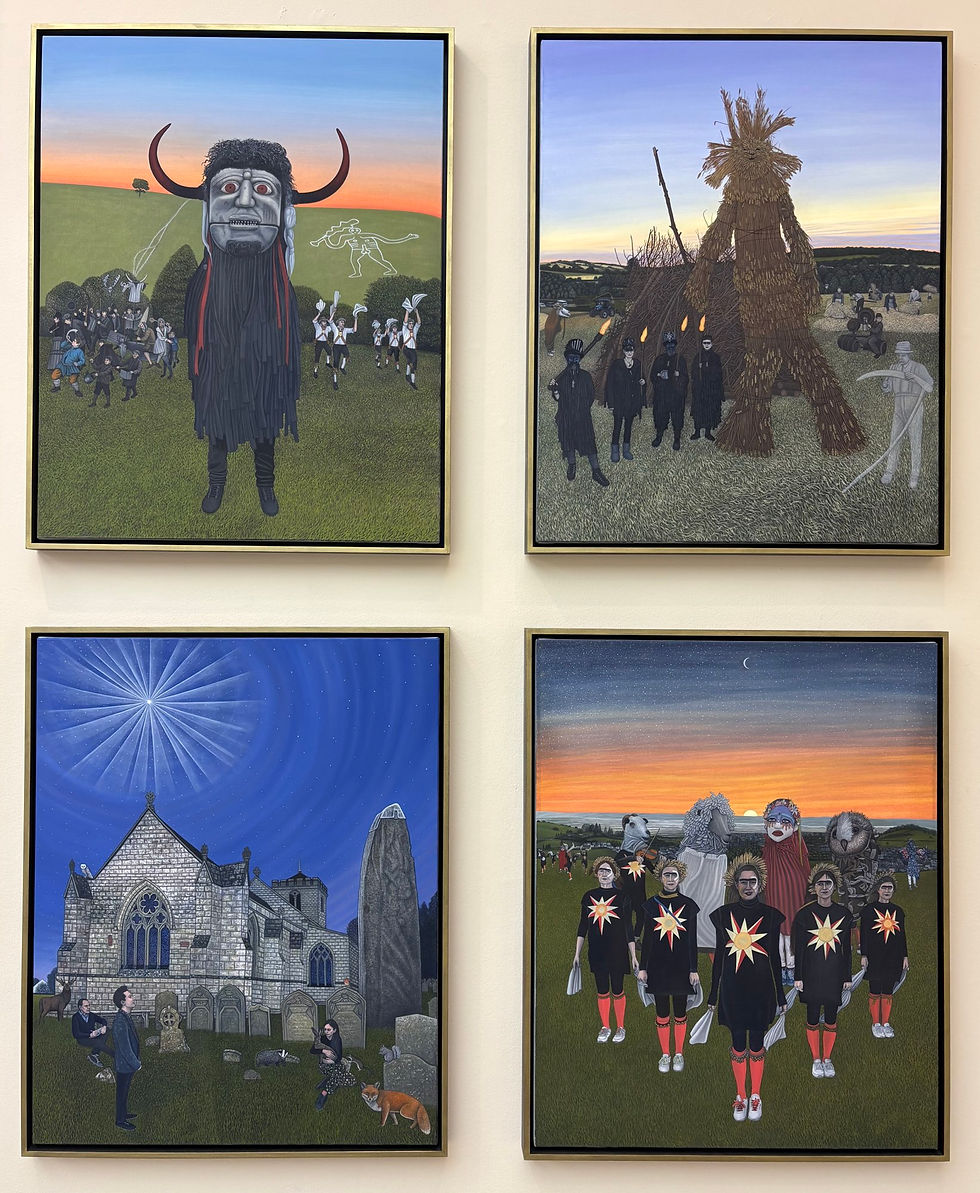
Clockwise from top left: The Dorset Ooser;
John Barley Corn Must Die; Boss Morris at Spring Equinox and Dreaming at Rudston Monolith,
2022-24
Oil on canvas
Courtesy of Private Collection
Ben Edge is an artist, songwriter, film maker, author and folklorist, whose work depicts the extraordinary lives of ordinary people. Edge has been obsessively documenting the seasonal customs of Britain culminating in the book Folklore Rising published by Watkins Publishing in 2024. (sg).

John Barleycorn: A Ballad
There was three kings into the east, Three kings both great and high, And they hae sworn a solemn oath John Barleycorn should die. They took a plough and plough'd him down, Put clods upon his head, And they hae sworn a solemn oath John Barleycorn was dead. But the chearful Spring came kindly on, And show'rs began to fall; John Barleycorn got up again, And sore surpris'd them all. The sultry suns of Summer came, And he grew thick and strong, His head weel arm'd wi' pointed spears, That no one should him wrong. The sober Autumn enter'd mild, When he grew wan and pale; His bending joints and drooping head Show'd he began to fail. His colour sicken'd more and more, He faded into age; And then his enemies began To show their deadly rage. They've taen a weapon, long and sharp, And cut him by the knee; Then ty'd him fast upon a cart, Like a rogue for forgerie. They laid him down upon his back, And cudgell'd him full sore; They hung him up before the storm, And turn'd him o'er and o'er. They filled up a darksome pit With water to the brim; They heaved in John Barleycorn, There let him sink or swim. They laid him out upon the floor, To work him farther woe; And still, as signs of life appear'd, They toss'd him to and fro. They wasted, o'er a scorching flame, The marrow of his bones; But a miller us'd him worst of all, For he crush'd him between two stones. And they hae taen his very heart's blood, And drank it round and round; And still the more and more they drank, Their joy did more abound. John Barleycorn was a hero bold, Of noble enterprise; For if you do but taste his blood, 'Twill make your courage rise. 'Twill make a man forget his woe; 'Twill heighten all his joy; 'Twill make the widow's heart to sing, Tho' the tear were in her eye. Then let us toast John Barleycorn, Each man a glass in hand; And may his great posterity Ne'er fail in old Scotland!
~ by Robert Burns; a song written in 1782 ~
Our Song
Our song is the slamming screen door
Sneakin' out late, tapping on your window
When we're on the phone, and you talk real slow
'Cause it's late, and your mama don't know
Our song is the way you laugh
The first date, "Man, I didn't kiss her, and I should have"
And when I got home, 'fore I said, "Amen"
Asking God if he could play it again
~ from Our Song by Taylor Swift ~

Soil, Glue, Pigment, Watercolor, Brass powder on Wooden panel
Courtesy of the artist and Private
Pretty in Pink
Pink isn't just a colour, it's an attitude!
~ Miley Cyrus ~

Discarded baling twine
Courtesy of the artist
This work is made from discarded baling twine donated by farmers in Oxfordshire and West Berkshire. Baling twine is used by farmers and horse owners to tie hay and straw bales together, once used it is often burnt or added to landfill. Through a self-developed weaving process, Fleming transforms this waste material into ambiguous sculptural forms.
Fleming does not dye any of the twines, her colour pallet is dependent on what twines are discarded by the farmers at any given time. Her work is indirectly reliant on the environment, climate and the seasons - the twine is available after animals have been housed (usually in the winter) or fed. In the summer months, twine is not used.
Climate change impacts the traditional indigenous crop cycle resulting in a reduction of the harvest of cereal crops and hay-resulting in less hay and straw bales to bind with twine, thus, leading to a reduction in twine.
This work loosely references local traditions that are connected to the land, the shape of the work evokes traditional stacking of hay before mechanisation and combine harvesters. Presenting a strange meeting of past, present and future. (sg).
Sun Tree
What is the good of your stars and trees, your sunrise and the wind, if they do not enter into our daily lives?
~ E.M. Forster ~

Natural pigments on recycled hemp paper
Courtesy of the artist and Private Collection
Warriors of the Sun

Mixed media, collage
Courtesy of Collection RAW
Eagle and Jaguar warriors were the specialised military forces of the Aztec Empire, often serving as "warriors of the Sun". These high-ranking soldiers, typically nobles, played crucial roles in capturing enemies for sacrifice to nourish the sun god, with eagles representing the sun and jaguars representing the night sky. (sg).
Awash
L to R
Raging at the Close of Day, 2026. By Henrietta Hoyer Millar. Oil on gessor board. Courtesy of the artist and Long Ryle Gallery. Inspired by the varying shapes and shades of her surroundings, Henrietta Hoyer Millar paints exquisite landscapes from her studio in Dorset.
Frith Farm, 1974. By John Titchell. Oil. Courtesy of the Estate of J. Titchell. Titchell was described by described by Kenneth Clark as "the Seurat of Kent".
Sun Sang, 1969 by Ian Fleming. Oil on board. Courtesy of the artist and The Fleming Collection. (Ian Fleming is unrelated to Ian Fleming the author - Fleming, the artist, was born in Glasgow and studied at the Glasgow School of Art. He began printmaking at art school, and Glasgow Art Gallery bought two of his prints while he was still a student.)
Fantastical Creatures

Oil on board
Courtesy of Williamson Art Gallery and Museum (Wirral Museums Services)
Jardine is considered 'Merseyside's Surrealist" and is known for his strange, wonderful, and at times slightly unsettling compositions. He was intrigued by the see-saw between imagination and stark materialism, and resulted in the unique blending of naturalism, surrealism and Victorian fantasy that is characteristic to his work.
Jardine taught graphics, collage, drawing and book illustration at Liverpool College of Art, often taking inspiration from children's books for his own fantastical pieces, such as Lunar Episodes - the body of work which this work belongs. Lunar Episodes began in 1938, after visiting a surrealist exhibition at Walker Art Gallery which featured artists such as Dali and Ernst. Scenes such as Moon in a Cage contain fantastical combinations of animals, people, strange contraptions and, usually, the moon. The series builds up into a strange, unique and dream-like world, reminiscent of fairy tales and children's story books. (sg)
Fact and Fiction

Paper cut sculpture
Courtesy of Long & Ryle Gallery
Fiction: The Black Knight is a classic antagonist in Arthurian Legend.
Fact: The most prominent historical figure known as the Black Knight (properly "The Black Prince") was Edward of Woodstock (1330–1376). He was the eldest son of King Edward III of England.
Helios

Burnt Kozuke Paper, 22 carot gold backing panel
Courtesy of the artist
Emilie Pugh's work is guided by an interest in the interconnectivity of all living things. It draws on systems of belief from the spiritual to the scientific, the micro to the macro and the conflicting or confluent universal forces that govern them. In ancient Greek religion and mythology, Helios is the god who personifies the sun. (sg)
Op(tical) Art
Since 1961, Bridget Riley (b. 1931) has focused exclusively on seemingly simple geometric forms, such as lines, circles, curves, and squares, arrayed across a surface—whether a canvas, a wall, or paper—according to an internal logic. The resulting compositions actively engage the viewer, at times triggering sensations of vibration and movement. This sense of dynamism was explored to great effect in the artist's earliest black-and-white paintings, which established the basis of her enduring formal vocabulary. In 1967, Riley introduced color into her work, thus expanding the perceptual and optical possibilities of her compositions. (text by David Zwirner).

Gouache and pencil
Courtesy of The Victoria Gallery and Museum, University of Liverpool
The colours in 'Ra' were inspired by Riley's trip to Egypt in the early 1980s. Upon returning, she created several series using warm hues and vibrant colours, including 'Ka' and 'Ra'. Ra is the ancient Egyptian deity of the sun, regarded as the king of the gods, creator of all life, and patron of kingship. (sg)
Strange New Worlds - Nothing to Fear, Nothing to Doubt
I jumped in the river, what did I see?
Black-eyed angels swam with me
A moon full of stars and astral cars
And all the figures I used to see
~ from Pyramid Song, (Amnesiac).
lyrics by Philip James Selway / Jonathan Richard Guy Greenwood / Edward John O'brien / Thomas Edward Yorke / Colin Charles Greenwood ~

Donwood has created all the artwork for the rock band Radiohead with their singer, Thom Yorke. He also creates art for many of Yorke's other projects, including Atoms for Peace and the Smile. In 2002, Donwood and Yorke won a Grammy Award for Best Recording Package for the Radiohead album Amnesiac.

Comments