

Less is Moore at Kew

Updated: Jul 22
The most comprehensive presentation of Moore’s work in a generation.
Kew Gardens presents a once-in-a-generation exhibition of artworks by Henry Moore, one of the most influential and internationally recognised artists of the 20th century.
From 9 May 2026 to 31 January 2027, Henry Moore: Monumental Nature will showcase 30 works across Kew’s landscape and inside the iconic Temperate House, the largest surviving Victorian glasshouse in the world.
Selected snapshots (text by RBG Kew, unless otherwise attributed):

Bronze
Henry Moore Foundation: acquired 1987.

Moore thought deeply about the relationship between his sculptures and where they would be placed. He often created multiple bronze casts to sit in different locations, each one transforming how the work was experienced.
Large Reclining Figure 1984 is the enlargement of a 13-inch figure that Moore had originally created in 1938. This sculpture was completed just two years before his death. It was the result of Moore's fourth and final collaboration with renowned Chinese-American architect
I. M. Pei, known for iconic landmarks such as the glass pyramid at the Louvre Museum in Paris.
Their collaborations were a true partnership, and they consulted on scale, placement and form. Moore's curved and fluid bronze sculptures provided a a contrast to Pei's sharp-edged modernist architectural designs. This fibreglass cast of the sculpture is the only non-bronze Moore sculpture on display at Kew.
'The tall building behind the sculpture is the Pagoda, which is a very famous building at Kew. The sculpture has a kind of horizontal organic form and then you ve got the Pagoda which is this kind of tall, vertical, geometric form. So, they're very contrasting but actually I think they complement each other?
Suzie Jewell, Garden Designer, RBG Kew.
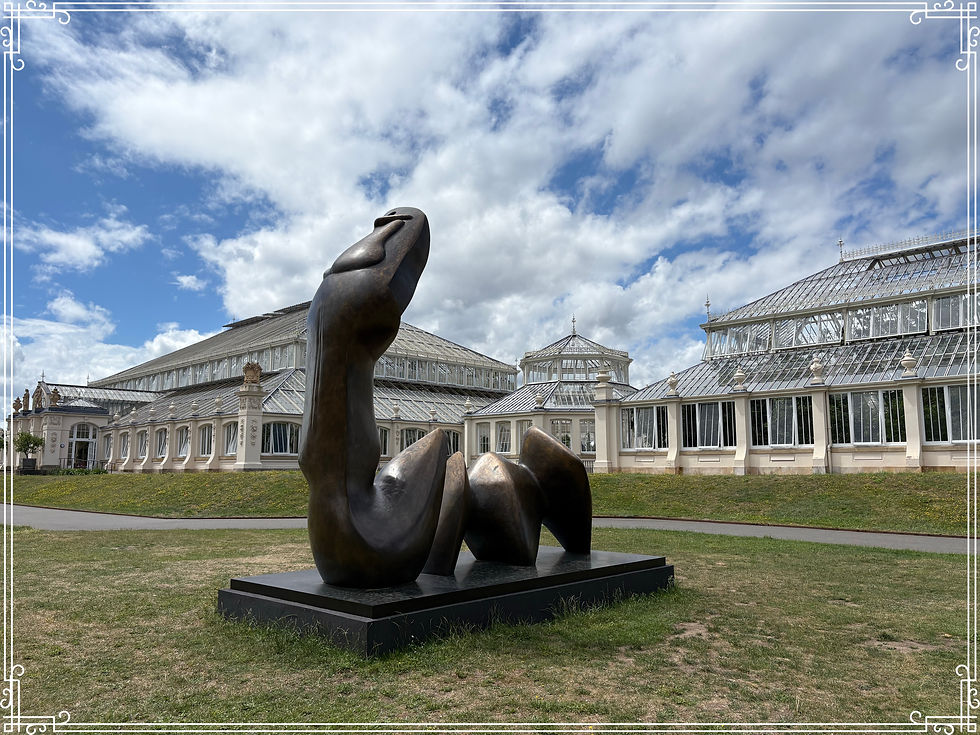
Bronze
Henry Moore Foundation: acquired 1986.
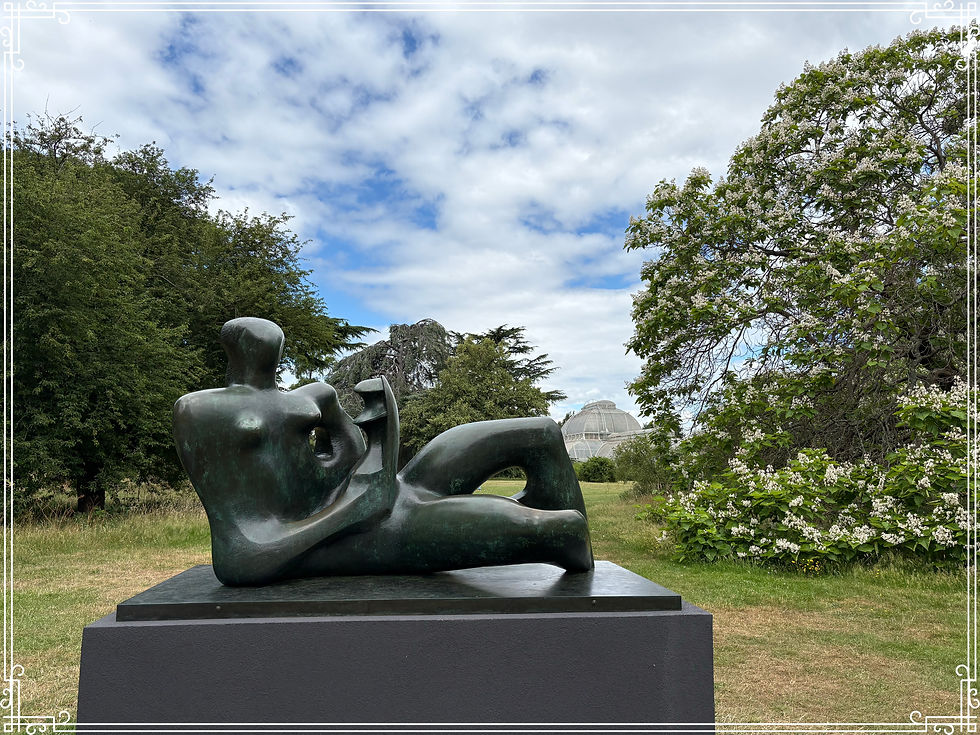
Bronze
Henry Moore Foundation: acquired 1986.

Bronze
Henry Moore Foundation: gift of the artist 1977.

Bronze
Henry Moore Foundation: gift of the artist 1977.

Bronze
Henry Moore Foundation: acquired 1987.


Bronze
Henry Moore Foundation: gift of the artist 1977.

In Three Piece Sculpture: Vertebrae 1968-69, Moore took inspiration from real bones to create three smooth forms that look like giant backbones, or vertebrae, that fit together like a puzzle.
This sculpture was created in four sizes, driven by Moore's desire to work in three dimensions and to create versions that suited specific locations. Moore began by creating a plaster maquette (a small model), followed by a larger working model cast in bronze.
He then developed this large bronze and finally, ten years later, the largest version, which is nearly double the size, for the new city hall in Dallas, Texas in 1978.
“I tried several ideas before this one, and what led me to this solution was finding a little piece of bone that was the middle of a vertebra, and I realised then that perhaps the connection was through one piece to another - one could have gone on and made a four- or five-piece, like a snake carrying through with its vertebrae?”
Henry Moore

Large Interior Form appears abstract but actually represents the human figure. Moore tried to create "organisms that must be complete in themselves," and to give the impression of his sculptures, "having grown organically, created by pressure from within."
Referring to the voids common to his sculptures, Moore said that holes make an object look more three-dimensional by connecting one side with the other. The three voids in this artwork were inspired by holes the artist observed in pebbles he found at the seashore.
(Text by Public Art Archive).

The three elements of this late, monumental, reclining figure incorporate smooth and curvaceous passages which are sharply cut into stump-like forms. The largest part, a rising chest and neck, juxtaposes one amputated arm with a heavily bowed and bulbous counterpart which merges with the torso. The torso juts up and outwards towards the centre of the composition before being bluntly severed. This treatment is echoed in the head, resulting in a blank facial plane. The verticality of this element contrasts with the horizontal arched ‘skirt’ of the figure, which shields a separate and more sinuous ‘leg-form’. The component parts are carefully spaced across the flat bronze base.
(Text by Henry Moore Foundation).


Comments